
How Tiger Sharks Help Map the Bahamas’ Seagrass: Science & Conservation at Tiger Beach
When you dive at Tiger Beach, the view underwater is often dominated by sharks, sand, blue water, but beneath that simplicity lies an ecosystem of remarkable complexity and importance. A recent study by Gallagher et al. (2022) shows that tiger sharks aren’t just subjects of fascination. They’re active allies in scientific efforts to map and protect the vast seagrass beds of The Bahamas.
Here’s what the science shows, and what it means for divers and conservation.
What the Study Did
- The team combined remote sensing (satellite imagery), human diver and tow-board surveys, and instrument-equipped tiger sharks (camera tags, satellite tags) to map seagrass across the Bahama Banks.
- They surveyed more than 2,500 benthic (seafloor) locations to verify what different sensing methods predicted.
- Sharks were tagged and tracked, both for movement and for the habitat (via cameras) they traversed. This helped ground-truth areas where remote imagery may miss sparse or hard-to-see seagrass beds.
Key Findings
- The Bahama Banks likely contain at least ~66,990 km² of seagrass, and possibly up to ~92,524 km², depending on methods and data used. Nature
- Dense seagrass species (like Thalassia testudinum) dominate in certain areas, but many regions are covered by sparser species (e.g. Halophila, Halodule) that are harder to detect via satellite. Sharks helped fill in those gaps. Nature
- When equipped with cameras, tiger sharks spent ~70% of their time over seagrass habitat in shallow bank areas. Nature
Why This Matters for Divers & Conservation
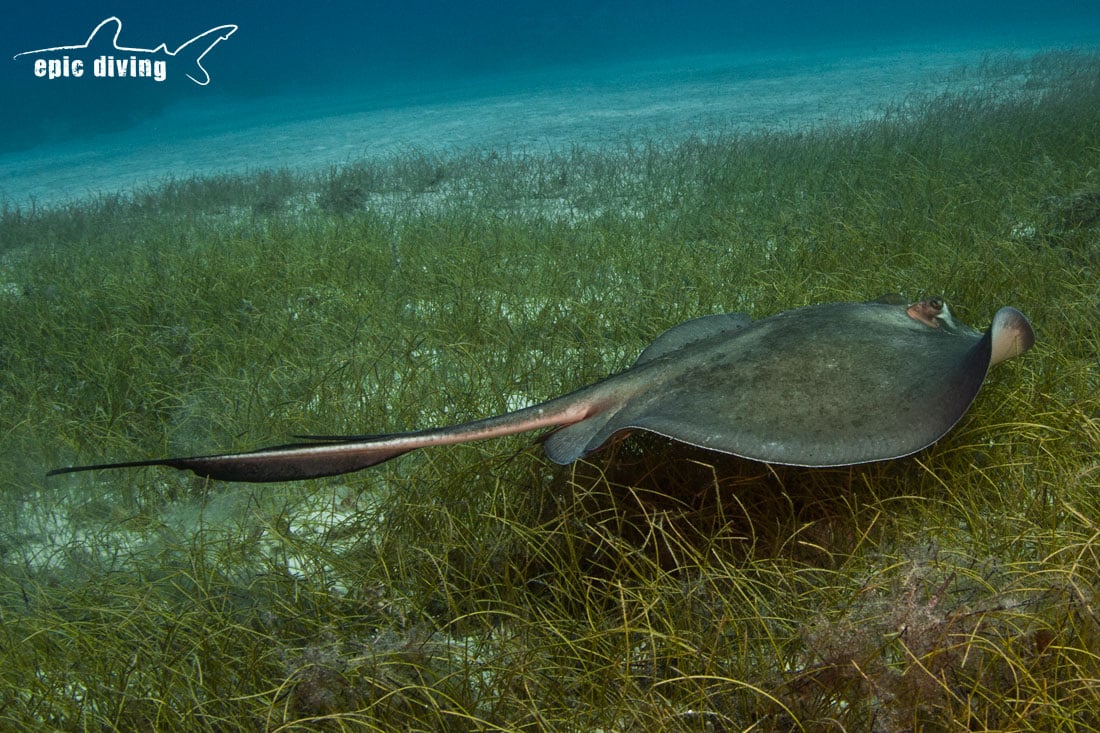
- Deeper appreciation of the dive environment: Knowing that those wide swaths of underwater you’re gliding over are part of one of the world’s largest seagrass ecosystems adds richness to what you see. It’s not just sand + sharks; it’s seagrass, life, carbon storage, ecological interconnections.
- Science in action: Shark behavior (where they swim, what depth they use, the habitats they prefer) helps scientists map habitat better. The sharks are contributing to environmental knowledge simply by being themselves in their natural habitat.
- Seagrass is under threat: Because sparse meadows are easily missed, remote sensing alone might miss damage, die-off, or decline. Having multiple methods, including shark-based observations, helps catch changes early. This is vital if we want the region to continue supporting biodiversity, fisheries, and shore protection.
How Epic Diving Incorporates This
- We use dive paths and briefings not just to show sharks, but to share with guests what we know about the substrate below — whether you’re diving over dense seagrass or more sparse cover.
- Guests often ask about the health of underwater ecosystems, this gives us real, recent scientific backing for those conversations.
- Conservation partnerships and messaging benefit, being able to say “our site is part of one of the world’s largest blue carbon ecosystems, and our sharks are part of monitoring that” adds powerful narrative to what we offer.
FAQs:
Seagrass traps carbon in its sediments, carbon that would otherwise contribute to atmospheric CO₂. Healthy seagrass ecosystems help mitigate climate change, protect shorelines, and support marine life.
With camera tags and movement tracking, sharks swim over habitats and collect imagery that scientists use to ground-truth satellite predictions. Because sharks move across broader areas than divers alone, they help fill gaps.
Not always. They’re very useful, but sparse or thin meadows are often missed. The study shows combining remote sensing with animal-mounted cameras and diver surveys gives a much fuller picture.
Yes — sharks show habitat preference; much of their upstream bank travel is over seagrass. It influences what you’ll see underwater, the clarity, the sandy vs grassy bottom texture, possibly the presence of prey species.
Conclusion
The underwater world around Tiger Beach is richer than you might see at first glance. The seafloor isn’t just sand. Often it’s grass, ecosystems of plants, fish, carbon, and life interwoven with the movements of apex predators. Studies like this remind us that tiger sharks aren’t just subjects of conservation. They’re partners in understanding the ocean more deeply.
When you dive with Epic Diving, you’re not just viewing sharks; you’re glimpsing ecosystems that matter to climate, wildlife, and our shared future. Protecting those ecosystems makes the difference between a dive and something truly meaningful.


